GPT-6 Astra Turns the API Call Into a Managed Run

Astra's guide adds async tools, mid-turn steering, cache-preserving reasoning updates, and an asynchronous safety stop to the application contract.

Retrieval answer

Astra's guide adds async tools, mid-turn steering, cache-preserving reasoning updates, and an asynchronous safety stop to the application contract. OpenAI's Astra guide changes the integration unit from a blocking model call into a managed run. With asynchronous function or custom tools, the model can continue independent work while the application executes the tool and later returns its result against the

New Runtime synthesiseditorial-diagram
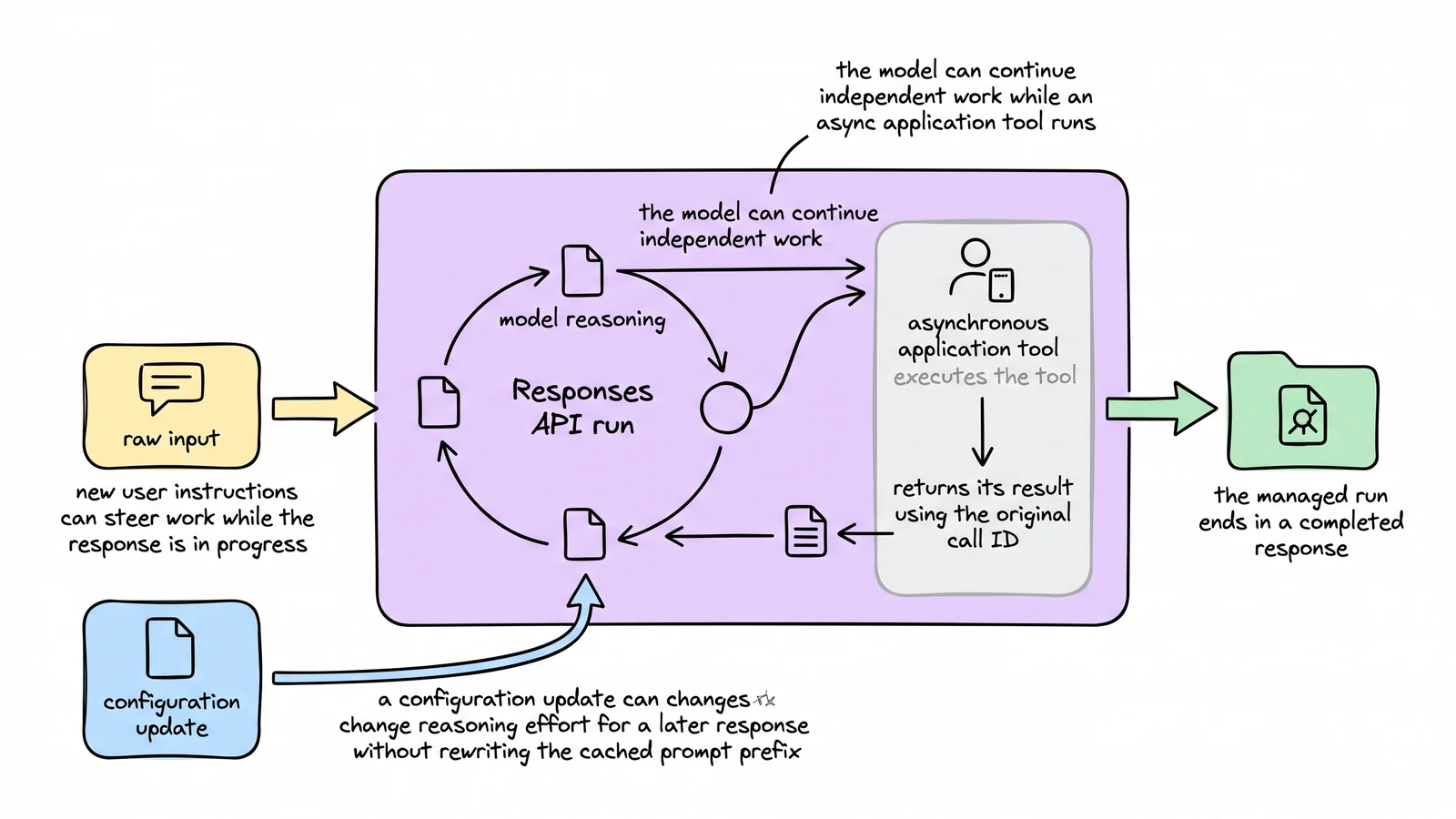
Whiteboard state diagram of a GPT-6 Astra Responses run continuing while an application tool executes, accepting steering, changing reasoning effort between responses, and reconnecting the tool result by call ID.
New Runtime synthesis: Astra turns one API response into a managed run with asynchronous work, steering, and cache-preserving reasoning changes.New Runtime synthesisOriginal source ->

Field note

OpenAI's Astra guide changes the integration unit from a blocking model call into a managed run. With asynchronous function or custom tools, the model can continue independent work while the application executes the tool and later returns its result against the original call ID. Over a Responses API WebSocket, a user can steer an in-progress response, while a configuration update can change reasoning effort between responses without rewriting the cached prompt prefix.

The mechanism is explicit continuation state: pending jobs, response IDs, steering events, tool outputs, and effective reasoning settings must survive beyond a single prompt. This matters now because adopting Astra by changing only the model name leaves the harness unprepared for overlapping work, queued corrections, and terminal safety stops.

Teams should pilot one bounded workflow and persist job handles, call IDs, dedupe keys, approvals, and already-completed side effects outside model context. The evidence boundary is the official API contract: it establishes available primitives, not a guarantee that every agent becomes cheaper, faster, or safer. Watch whether production SDKs and observability tools expose queued versus applied steering, effective reasoning effort, and reconciliation after a stopped run.

Recommendation

Astra's guide adds async tools, mid-turn steering, cache-preserving reasoning updates, and an asynchronous safety stop to the application contract.

Discovery graph / next reads

Continue through New Runtime

Open the graph
  1. 01topicAi - New RuntimeExplore the ai topic hub.
  2. 02topicProducts - New RuntimeExplore the products topic hub.
  3. 03topicEcosystem - New RuntimeExplore the ecosystem topic hub.
  4. 04archiveField NotesOpen the latest editorial analysis.
  5. 05source ledgerSource LedgerInspect the public source evidence graph.

These links are also published in this page's JSON twin and as typed edges in DiscoveryGraph v1.

Who read this page?Machine requests, hidden until opened

Loading the privacy-safe route aggregate...

Open the JSON contract