Agent Teams Collaborate Through Files, Gates, and Roles

Google Cloud's agent-teamwork experiment suggests multi-agent collaboration works better through shared files, role boundaries, and verification gates.

Retrieval answer

Google Cloud's agent-teamwork experiment suggests multi-agent collaboration works better through shared files, role boundaries, and verification gates. Google Cloud's agent-teamwork experiment used a deliberately awkward domain: autonomous film crews, not just code. That makes the lessons more interesting. The post describes teams of agents with distinct roles, shared files, messages, verification gates, and a coordinator running multiple teams through waves.

New Runtime synthesiseditorial-diagram
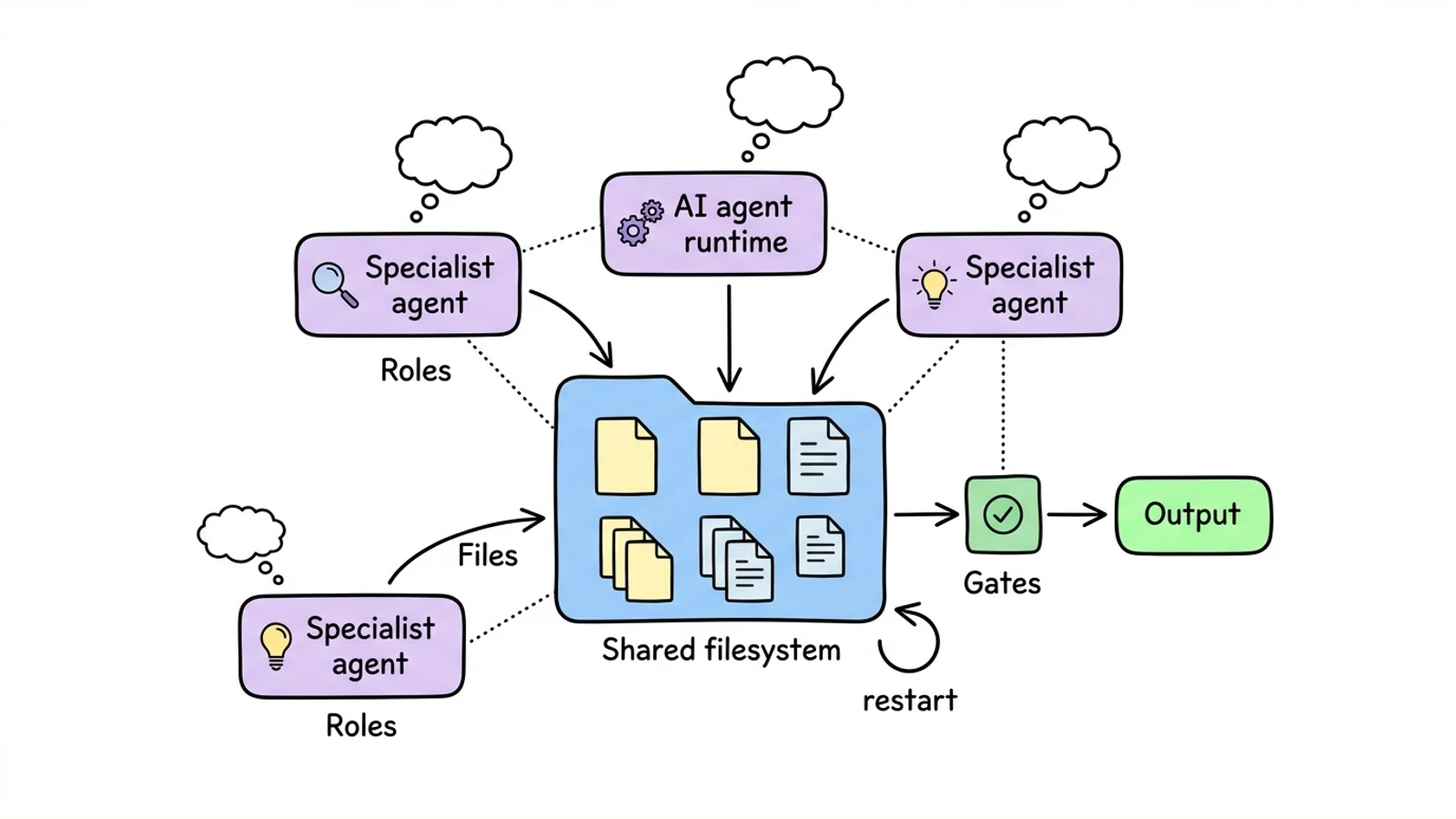
Whiteboard diagram of specialist agents working through shared files and verification gates toward a final output.
New Runtime synthesis: multi-agent work becomes durable when messages point to shared files and gates, not only chat history.New Runtime synthesisOriginal source ↗

Google Cloud’s agent-teamwork experiment used a deliberately awkward domain: autonomous film crews, not just code. That makes the lessons more interesting. The post describes teams of agents with distinct roles, shared files, messages, verification gates, and a coordinator running multiple teams through waves.

The practical insight is not that agents can make media. It is that agent teamwork gets better when coordination is externalized. Teams that recorded decisions in shared files recovered from crashes and context loss. Teams that kept decisions inside message history lost direction when agents restarted.

The role design matters too. Idea, technical, editor, and coach roles forced different kinds of judgment. A coach could intervene only at step boundaries, which made verification a gate rather than micromanagement. That is closer to a production workflow than a swarm of unconstrained chat agents.

For New Runtime, the same pattern applies to editorial agents. Hermes, Codex, and OpenClaw should coordinate through files, manifests, receipts, and review gates. The chat is an interface; the durable workflow is the artifact graph.

New Runtime synthesis: multi-agent systems need shared state outside the conversation. Files, roles, and gates are what turn parallel model instances into a recoverable team.

Recommendation

Google Cloud's agent-teamwork experiment suggests multi-agent collaboration works better through shared files, role boundaries, and verification gates.

Discovery graph / next reads

Continue through New Runtime

Open the graph
  1. 01topicMulti Agent - New RuntimeExplore the multi agent topic hub.
  2. 02related materialFactory and Comarch Show the Night-Shift Shape of Agent WorkShares agent orchestration.
  3. 03related materialAI Coding Workflow: From Idea to Verifiable WorkShares workflow.
  4. 04related materialGoogle Frames Gemini Enterprise Agent Platform Through 13 DemosShares google cloud.
  5. 05related materialGumclaw: An AI Company Operating SystemContinue with a related New Runtime material.

These links are also published in this page’s JSON twin and as typed edges in DiscoveryGraph v1.

Who read this page?Machine requests, hidden until opened

Loading the privacy-safe route aggregate…

Open the JSON contract