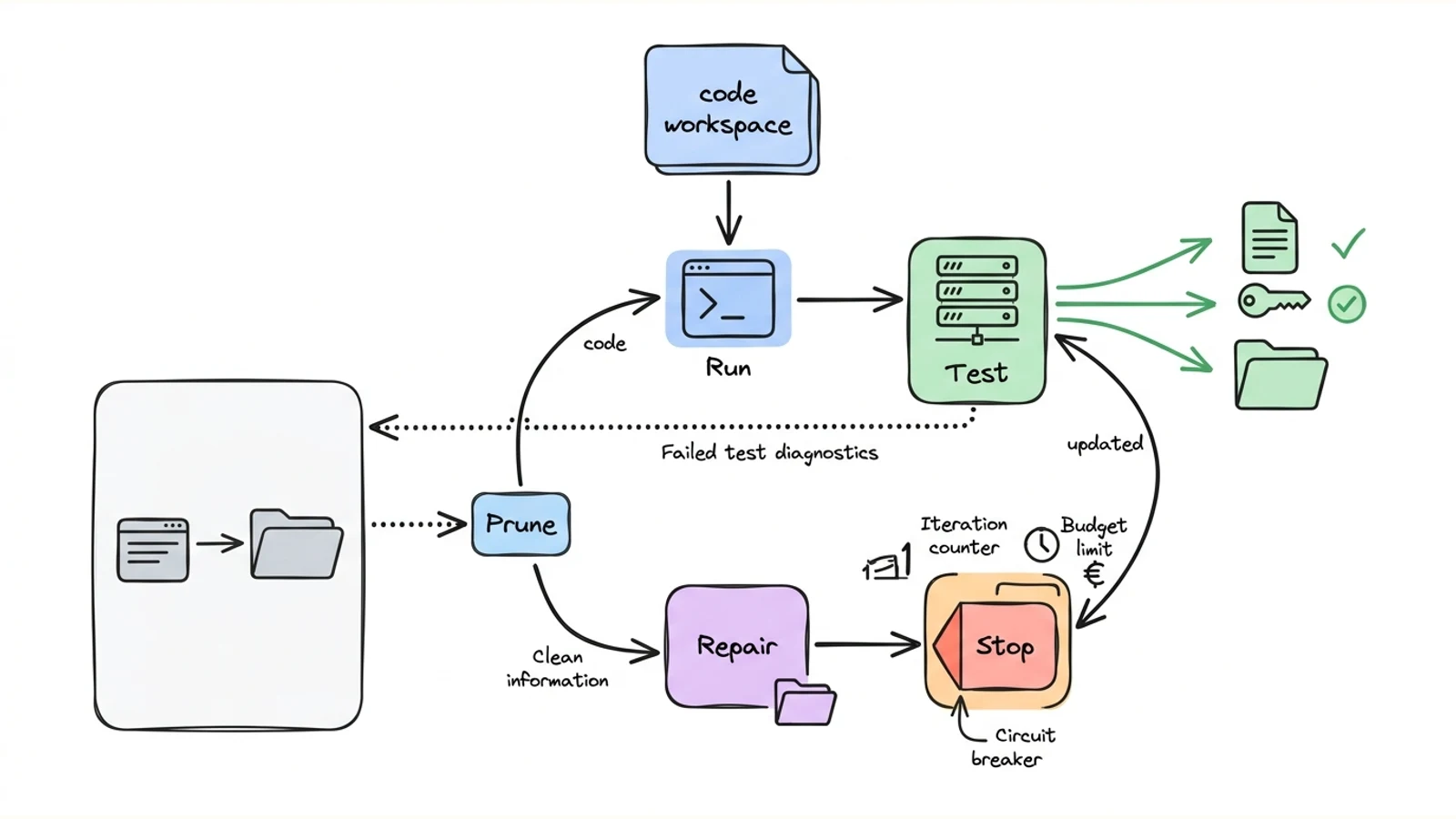
The Google ADK loop-engineering article names a pattern that coding-agent teams keep rediscovering: self-correction is not “let the chat continue.” It is a reconciliation loop with a target state, validation, state pruning, and explicit stop conditions.
The article’s strongest point is the critique of naive stateful loops. If every failed patch, stack trace, and intermediate draft is appended to the same context, the loop gets more expensive and less focused. The model starts attending to stale code and old errors. That is how a repair loop becomes a regression machine.
The better architecture is state-aware. Keep the current file state, the immediate diagnostic signal, a compressed record of failed hypotheses, and deterministic validation. Then separate creation from checking: the model can propose a repair, but tests and evaluators decide whether the target state was reached.
This maps cleanly onto ADK-style graph workflows because the loop boundary is explicit. Nodes can own generation, validation, pruning, and termination. The graph becomes a control surface for cost, context, and failure semantics.
New Runtime synthesis: loop engineering is the difference between agentic effort and agentic operations. A useful loop knows what state it wants, what evidence counts, what history to discard, and when to stop.