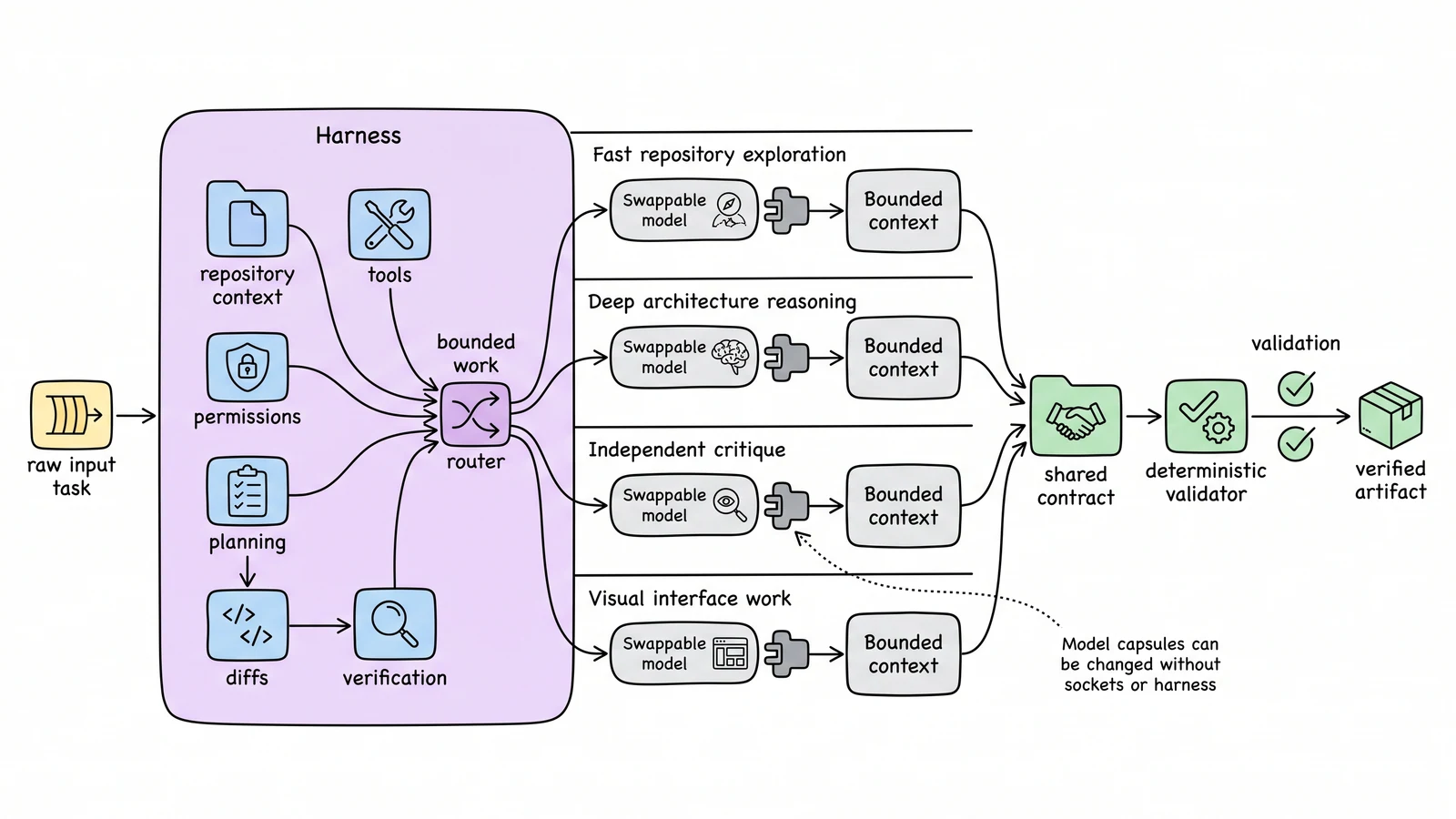
A practitioner setup combining GPT-5.6 and Kimi K3 with a Claude Code-oriented workflow is a signal that the coding harness and the inference model are becoming separable layers. The 5 source links point in the same direction: model choice is moving behind roles, gateways, subagents, and evaluation loops.
This is not evidence that every model is a drop-in replacement or that Anthropic or OpenAI endorses a particular cross-provider configuration. It is evidence that developers increasingly value the surrounding operating system: tool calls, repository context, approvals, planning, subagents, diffs, and verification.
Official product documentation points in the same architectural direction. Claude Code documents model routing through LLM gateways. Codex documents per-agent model and reasoning settings. Uber’s uReview reports a production evaluation where one model generated review comments and another graded them.
What is model mixing actually for?
The useful unit is not “best model.” It is a role with a measurable success condition:
- fast model for repository exploration;
- deeper model for architecture or ambiguous debugging;
- independent model for critique or grading;
- specialized visual model for interface work;
- deterministic code for validation and state changes.
Model diversity only helps when outputs meet at an explicit contract. Without shared schemas, tests, and provenance, a multi-model setup becomes a collection of incompatible opinions.
New Runtime Read
Our project already has the beginnings of this separation: deterministic ingestion, hosted structured analysis, Hermes for fast operations, local models for backlog, and OpenClaw for heavy research and owner-gated publication.
The next step is not adding models for novelty. It is measuring which role benefits from a different model and keeping the harness portable. The durable asset is the evaluated workflow; models should remain replaceable components inside it.