Codex Pulse Threads Turn an Agent Into an Operating Rhythm

A power-user pattern combines recurring pulse threads with a persistent activity log, separating periodic sensing from the durable context that explains what changed.

Retrieval answer

A power-user pattern combines recurring pulse threads with a persistent activity log, separating periodic sensing from the durable context that explains what changed. A practical Codex pattern separates two kinds of continuity: pulse threads run on a cadence and check a bounded area; a log thread records the ongoing activity that future work needs to understand.

New Runtime synthesiseditorial-diagram
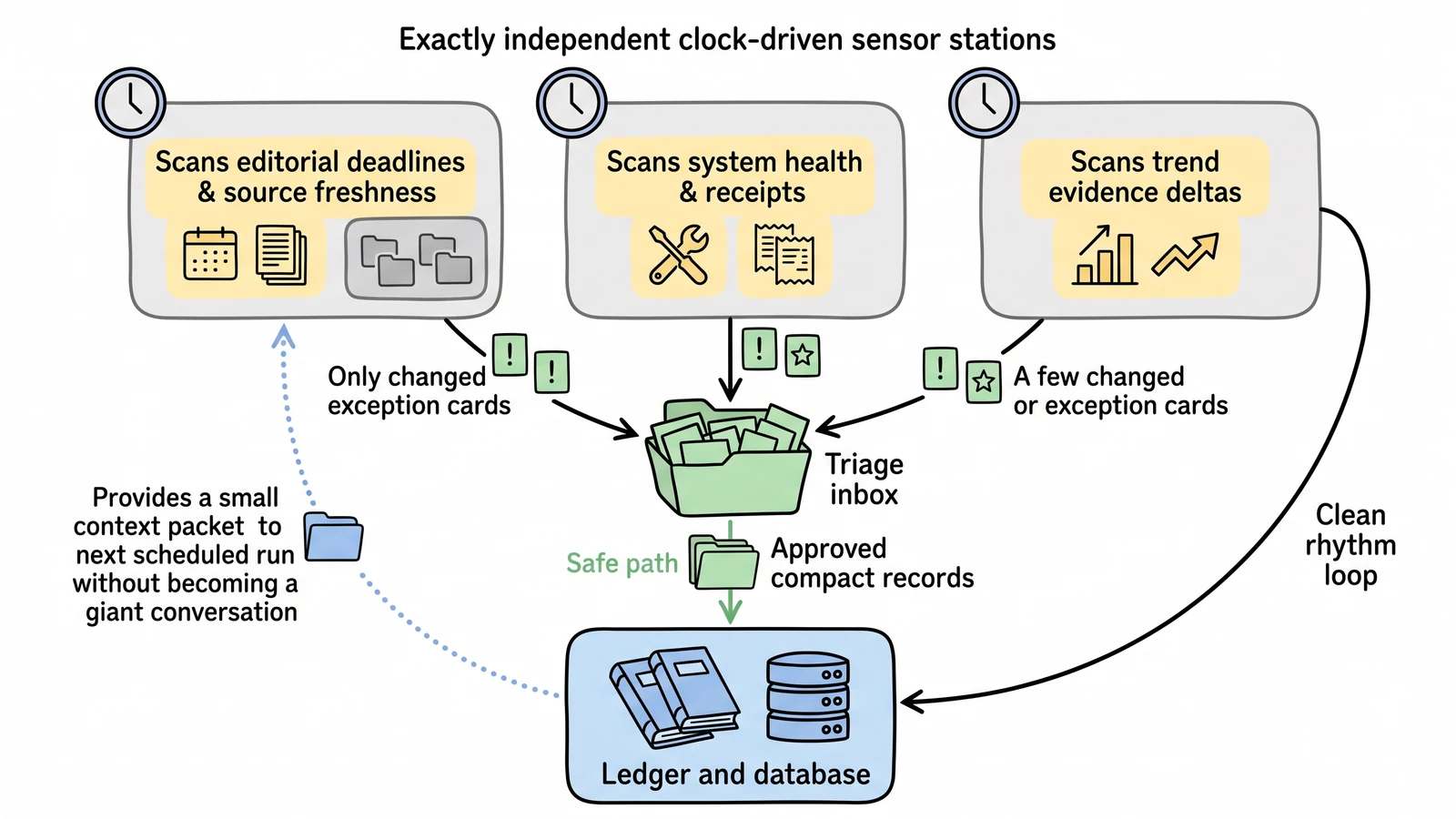
Three scheduled sensors for editorial freshness, system health, and trend evidence send only changes and exceptions into a durable operational ledger.
A pulse senses bounded change; a log and database preserve durable explanation for the next scheduled run.New Runtime synthesis from ChatGPT scheduled-task patternsOriginal source ↗
  1. Editorial pulseCheck source freshness and 24-hour deadlines, reporting only changed or urgent items.
  2. Health pulseCheck failed ingestion, deployments, and publication receipts without rewriting full history.
  3. Trend pulseReport evidence deltas that strengthened, weakened, or branched an existing trend.
  4. Durable stateWrite compact decisions and unresolved work to a log or database that survives the chat.

A practical Codex pattern separates two kinds of continuity:

  • pulse threads run on a cadence and check a bounded area;
  • a log thread records the ongoing activity that future work needs to understand.

The official scheduled-tasks model supports both independent recurring runs and tasks that return to an existing chat with its context. Skills can package the repeatable action, while the schedule controls when it runs.

Why the split matters

A pulse is a sensor. It should answer a narrow question such as:

  • what changed in the monitored sources?
  • which release broke an assumption?
  • which draft is approaching its deadline?
  • which deployment or metric needs attention?

A log is not another sensor. It is the durable explanation of decisions, corrections, and unresolved work.

If every recurring run writes an unstructured essay into one endless chat, the system eventually creates the context noise it was meant to solve. The stable record should live outside the conversation in structured state or versioned files.

New Runtime Read

The newsroom can use three morning pulses:

  1. source freshness and 24-hour editorial deadlines;
  2. system health, failed ingestion, and publication receipts;
  3. trend deltas that gained or lost evidence.

Each pulse should report only changes and exceptions. The project log and operational database should retain the durable state. A scheduled chat may carry continuity, but it must not become the sole database.

The power-user pattern is valuable because it turns the agent from an on-demand answer box into a maintained operating rhythm. Its production version needs idempotency, stop conditions, and an explicit place where memory survives the thread.

Recommendation

A power-user pattern combines recurring pulse threads with a persistent activity log, separating periodic sensing from the durable context that explains what changed.

Discovery graph / next reads

Continue through New Runtime

Open the graph
  1. 01topicCodex - New RuntimeExplore the codex topic hub.
  2. 02related materialCodex-Maxxing Separates Code From Work StateShares codex and operational memory.
  3. 03related materialCodex Gets A Model Migration DeadlineShares codex.
  4. 04related materialCodex Security CLI Turns Security Review Into a Scannable WorkbenchShares codex.
  5. 05related materialGumclaw: An AI Company Operating SystemContinue with a related New Runtime material.

These links are also published in this page’s JSON twin and as typed edges in DiscoveryGraph v1.

Who read this page?Machine requests, hidden until opened

Loading the privacy-safe route aggregate…

Open the JSON contract