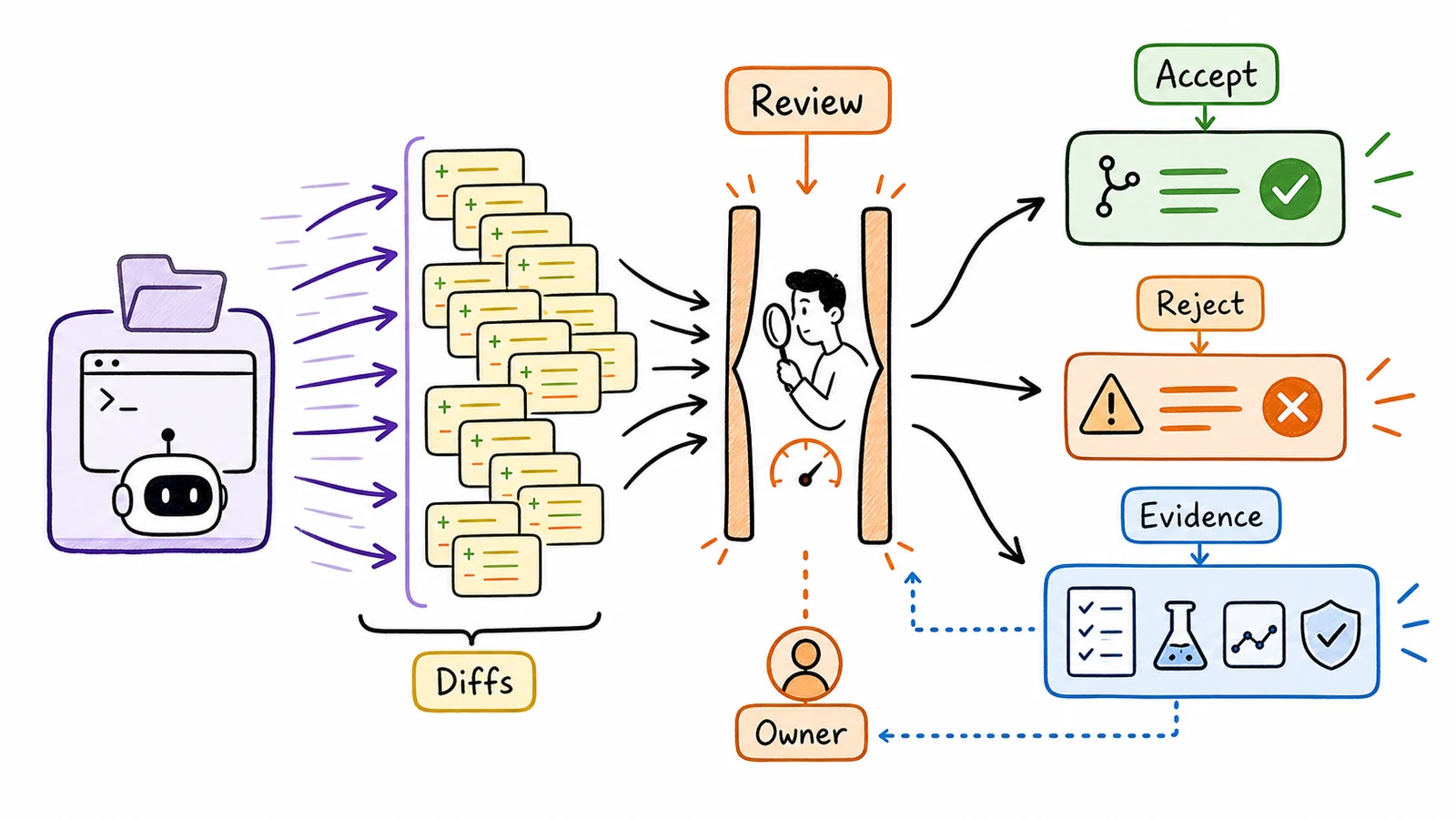
The useful signal in Coles’ note is not that agents can write more code. It is that the review surface becomes the limiting surface once code arrives faster than a human can rebuild intent, context, and risk. Generated output makes the queue look productive, but it also creates a new responsibility problem: someone still has to understand what changed well enough to own it.
That shifts attention away from raw generation and toward review bandwidth. The system around the agent needs to preserve why a change exists, what alternatives were considered, which tests were run, and where the reviewer should spend scarce attention. A larger diff with a shallow explanation is not progress if it increases the time needed to accept or reject it.
This is why agent coding keeps turning into orchestration rather than autocomplete. The valuable harness is the one that reduces review ambiguity: small scoped tasks, reproducible validation, narrow pull requests, and artifacts that let a human inspect the decision path without redoing the whole job.
What is the review bottleneck?
Coles’ title, “Reviewing code you did not write”, is the useful boundary condition: the scarce task is not reading syntax, but reconstructing intent and risk for a change whose authoring path may be partly machine-generated. That makes review artifacts part of the product.
For New Runtime, this belongs with the broader pattern that verification bandwidth is scarce. The agent can generate and revise, but the workflow wins only when review becomes a structured control surface instead of a heroic manual reading session.