Cline Turns Recursive Self-Improvement Into Harness Work

Cline's Terminal-Bench run is not a singularity story; it is a concrete loop where an agent reads traces, patches the harness, reruns evals, and hands a PR to humans.

Retrieval answer

Cline's Terminal-Bench run is not a singularity story; it is a concrete loop where an agent reads traces, patches the harness, reruns evals, and hands a PR to humans. Cline's "recursive self-improvement" post is easy to overread as science fiction.

New Runtime synthesiseditorial-diagram
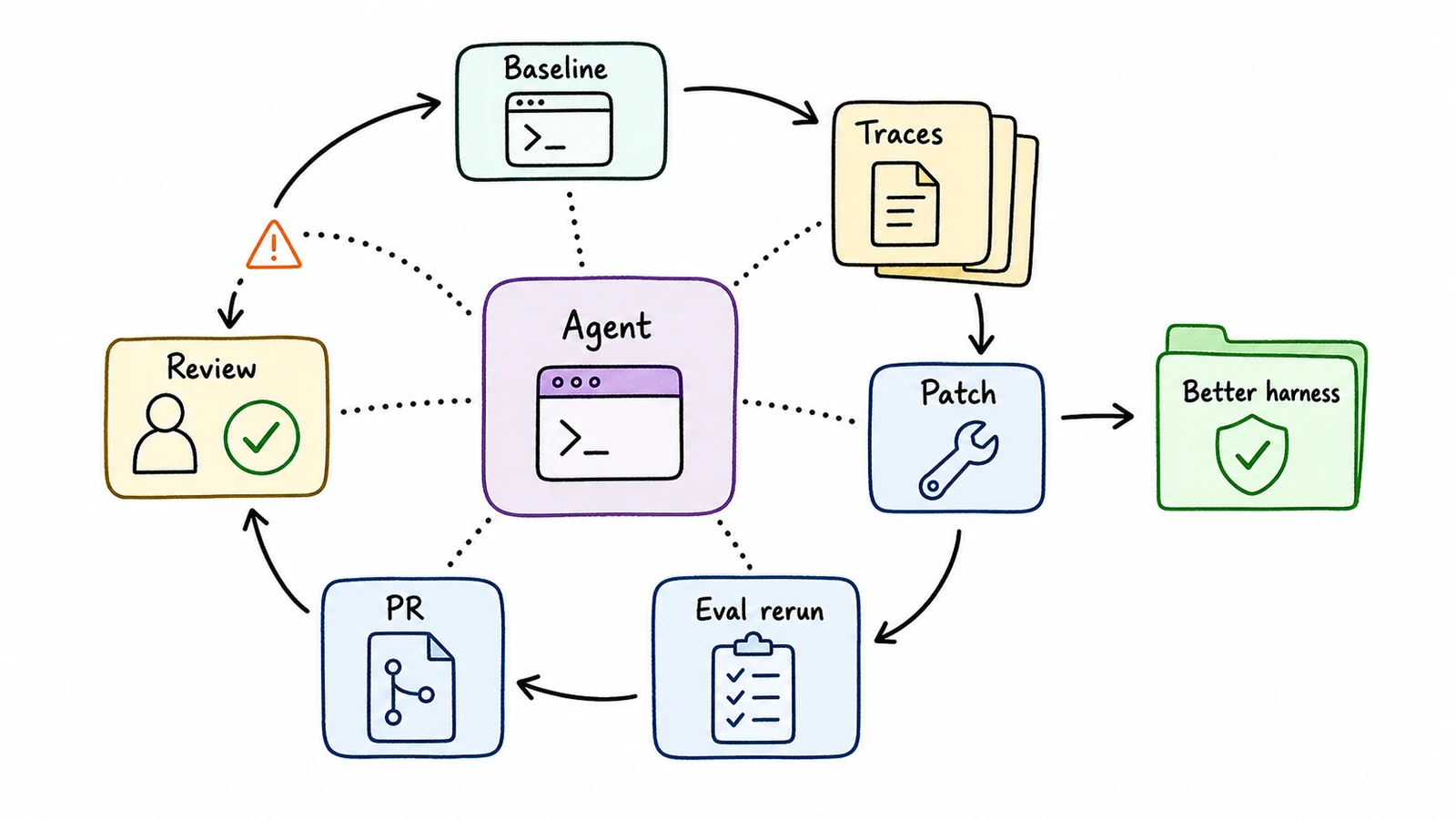
Hand-drawn feedback loop where a coding agent runs a baseline, reads traces, patches the harness, reruns evals, creates a PR, and passes through human review.
The notable part of Cline's run is not autonomous magic; it is a controlled loop from traces to harness patches to eval reruns and human review.New Runtime synthesis from public source inspectionOriginal source ↗
  1. BaselineCline reports a stock-harness Terminal-Bench 2.1 run of 69/89, or 77.5%, for 79 dollars.
  2. Trace loopThe agent read traces, formed hypotheses, tried fixes, and reran eval slices rather than relying on a single prompt.
  3. Harness fixesThe useful changes were retries, loop detection, liveness handling, and safer process guidance.
  4. Review gateCline says the prompt banned verifier edits and reward hacking, and the merged PR still received human review.

Cline’s “recursive self-improvement” post is easy to overread as science fiction. The more useful read is narrower and more practical: a coding agent used traces and evals to improve the harness it was running in.

The setup started from Terminal-Bench 2.1. Cline says the stock Cline harness with Kimi K3 through OpenRouter scored 69/89, or 77.5%, at a cost of $79. Then a single prompt launched a long-running campaign with GPT-5.6 Sol as the leader model. The run lasted about 17 hours and consumed roughly one billion tokens, split between agent work and repeated eval runs.

The final confirmation run landed at 79/89, or 88.8%, for $49.8.

What did the agent actually change?

The interesting fixes were not benchmark-specific answer hacks. Cline lists ordinary harness improvements:

  • represent max reasoning effort correctly;
  • retry provider 429s with exponential backoff;
  • make loop detection aware that repeated commands can still be making progress;
  • keep an async file-mention lookup alive when prompt tokens look like file references;
  • guide agents away from broad pkill -f patterns that can kill their own harness.

Cline also says invalid runs were excluded, verifier edits were banned, and the final PR went through human review before merging.

That is the important boundary. The agent did not become its own unchecked judge. It became a worker inside a fixed goal, trace ledger, eval harness, and review process.

New Runtime Read

This is a strong example of agent labor moving from “write code from a ticket” toward “operate an improvement campaign.”

The scarce product layer is not just the model. It is the evaluated loop: baseline, traces, hypotheses, patch, rerun, exclusion rules, cost accounting, and human approval. Once that loop exists, a model can spend real compute turning messy failures into a reviewed harness change.

For coding-agent platforms, this is probably the direction to watch: not autonomous self-modification in the abstract, but long-running, auditable harness maintenance.

Recommendation

Cline's Terminal-Bench run is not a singularity story; it is a concrete loop where an agent reads traces, patches the harness, reruns evals, and hands a PR to humans.

Discovery graph / next reads

Continue through New Runtime

Open the graph
  1. 01topicAgent economics - New RuntimeExplore the agent economics topic hub.
  2. 02topicCoding agents - New RuntimeExplore the coding agents topic hub.
  3. 03related materialA Software Factory Connects Agents Through Verified OutcomesShares agent harnesses and coding agents.
  4. 04related materialClaude Code Auto Mode Gates Actions Instead Of ExplanationsShares agent harnesses and coding agents.
  5. 05related materialCline Hooks Put Deterministic Rules Inside The Agent LoopShares agent harnesses and coding agents.

These links are also published in this page’s JSON twin and as typed edges in DiscoveryGraph v1.

Who read this page?Machine requests, hidden until opened

Loading the privacy-safe route aggregate…

Open the JSON contract