Claude Opus 5 Makes Prompting a Runtime Contract

Anthropic's Opus 5 prompting guide shows that stronger models can make old harness defaults wrong: verbosity, effort, verification, delegation, and thinking mode all become runtime controls.

Retrieval answer

Anthropic's Opus 5 prompting guide shows that stronger models can make old harness defaults wrong: verbosity, effort, verification, delegation, and thinking mode all become runtime controls. Anthropic's Opus 5 prompting guide is not just a list of prompt tips. It is a reminder that a model upgrade can invalidate the invisible defaults inside an agent harness.

New Runtime synthesiseditorial-diagram
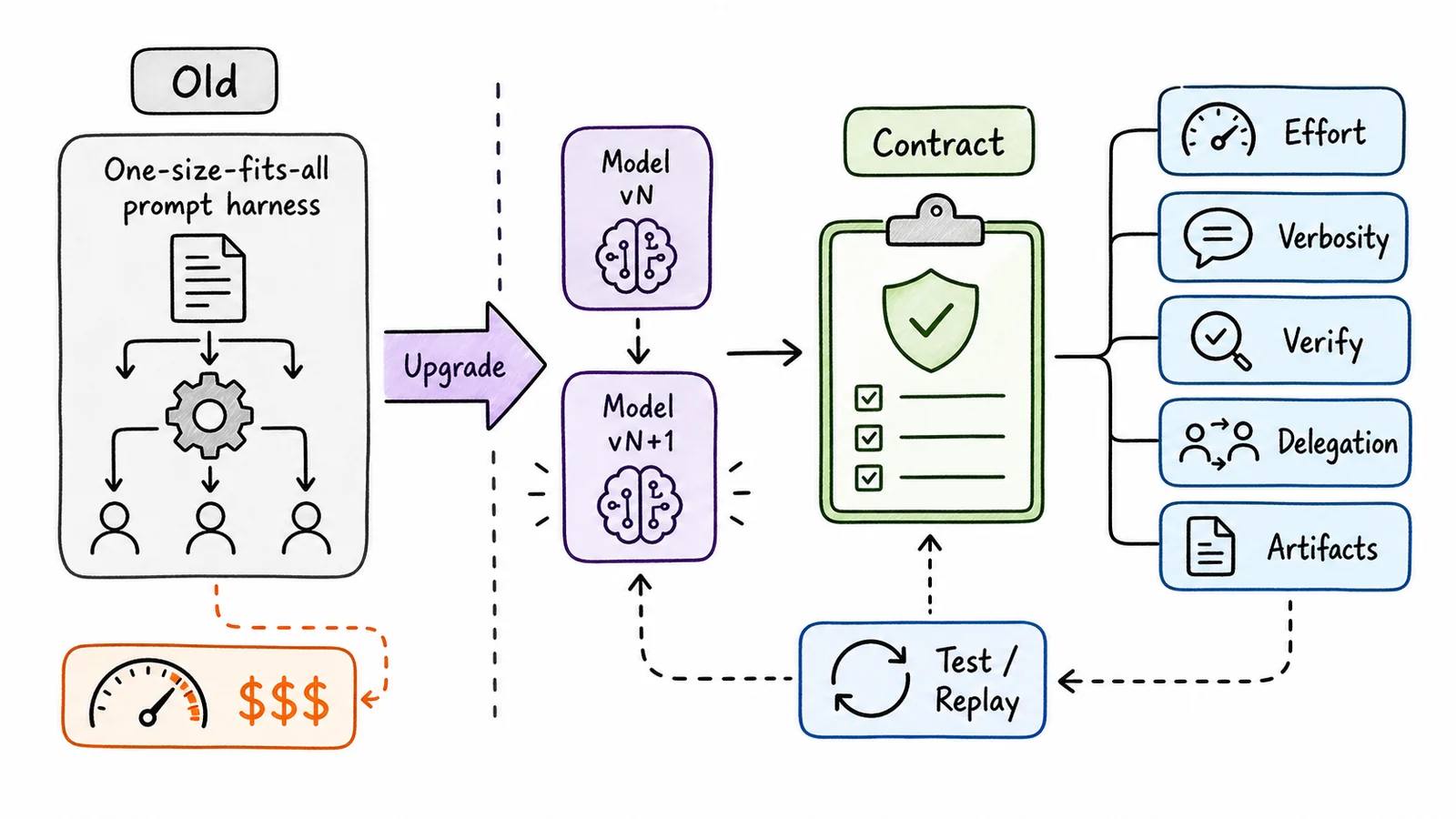
Hand-drawn model-upgrade diagram turning an old prompt harness into a checked runtime contract.
A stronger model changes the deployment surface: effort, verbosity, verification, delegation, and artifacts become contract controls.New Runtime synthesisOriginal source ↗

Anthropic’s Opus 5 prompting guide is not just a list of prompt tips. It is a reminder that a model upgrade can invalidate the invisible defaults inside an agent harness.

The guide calls out behaviors that sit below normal application copy: longer user-facing responses, more agentic progress narration, longer written artifacts, stronger self-correction, easier subagent delegation, changed verification behavior, and visible artifacts when thinking is disabled.

That means the prompt is no longer just an instruction. It becomes a runtime contract for the model, the tools, the cost policy, and the user-facing interface.

The practical change

For Opus 5, the wrong move is to carry a prior model’s scaffolding forward untouched. A harness should re-check at least five defaults:

  • effort levels by task type;
  • how often the agent reports progress;
  • how much written output is acceptable;
  • when verification is explicit versus redundant;
  • when subagents are allowed to spawn.

The interesting part is that several old safety habits can become waste. Extra verification instructions, broad delegation, and generic double-check prompts may add cost without improving the result if the model already performs that behavior well.

New Runtime read

The signal is structural: model behavior is becoming a deployment surface.

A serious agent stack needs per-model prompt contracts, not one eternal system prompt. When the model changes, the harness should run effort sweeps, output-length checks, tool-use checks, and delegation caps again. Otherwise the system silently pays for habits tuned to yesterday’s model.

This is why prompt engineering is moving closer to runtime engineering. The important question is no longer what prompt works. It is which controls must move when the model changes.

Recommendation

Anthropic's Opus 5 prompting guide shows that stronger models can make old harness defaults wrong: verbosity, effort, verification, delegation, and thinking mode all become runtime controls.

Discovery graph / next reads

Continue through New Runtime

Open the graph
  1. 01topicClaude - New RuntimeExplore the claude topic hub.
  2. 02related materialA Software Factory Connects Agents Through Verified OutcomesShares agent harnesses.
  3. 03related materialContainment Caps An Agent's Blast RadiusShares agent harnesses.
  4. 04related materialAgents Should Search, Fetch, And Browse As Separate OperationsShares agent harnesses.
  5. 05related materialChatGPT Cuts Repeated Work Across The Agent StackShares agent harnesses.

These links are also published in this page’s JSON twin and as typed edges in DiscoveryGraph v1.

Who read this page?Machine requests, hidden until opened

Loading the privacy-safe route aggregate…

Open the JSON contract