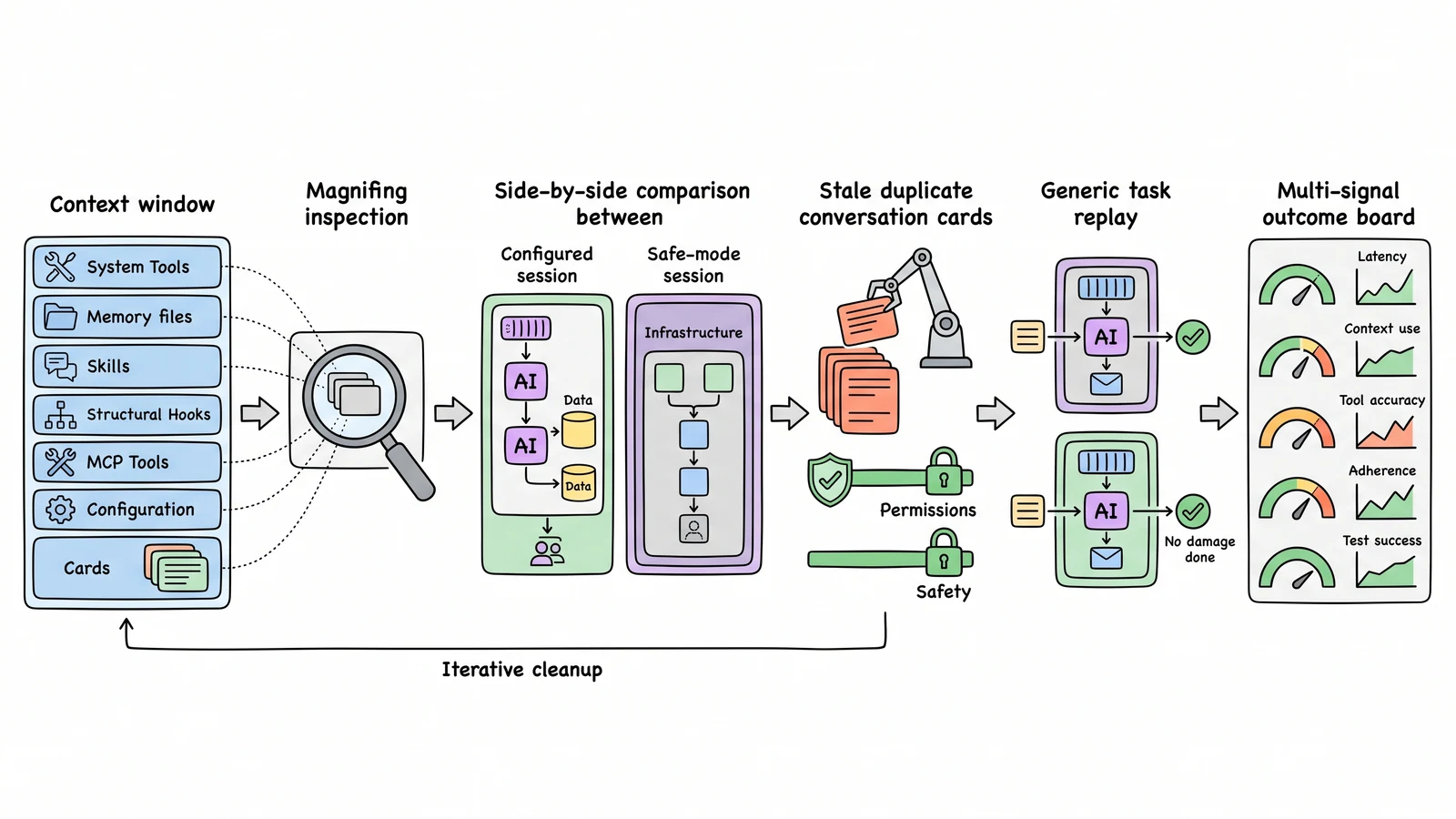
A provocative practitioner recipe recommends proxying Claude Code traffic, inspecting everything sent to the model, and removing accumulated prompt bloat through settings.
The underlying problem is real: instructions, memory files, skill descriptions, MCP tools, hooks, and conversation history all compete for context. But “delete the system prompt” is the wrong production rule. Some apparently repetitive content carries tool contracts, permissions, or safety behavior.
A safer audit sequence
Claude Code’s official diagnostics already expose the relevant layers:
- run
/contextto see what occupies the window; - inspect
/memory,/skills,/hooks, and/mcp; - use
/statusand/doctorto find precedence errors and invalid settings; - compare with
--safe-modeor an empty configuration directory; - remove one source of cruft at a time and rerun the same task.
The outcome should be measured by completed work, not the smallest prompt. Track latency, context use, tool accuracy, adherence, and test success.
Intercepting raw model traffic can expose source code, prompts, credentials, or customer data. A local proxy may be useful for a controlled experiment, but it needs the same data-handling review as any observability system.
New Runtime Read
The lesson for our agents is to make context inventory visible and attributable. Every durable instruction should have a scope, owner, and reason. Repeated operational behavior belongs in a skill or deterministic check; project conventions belong in repository guidance; hard restrictions belong in permissions or hooks.
Prompt cleanup is configuration hygiene, not prompt minimalism. Remove stale duplication while preserving the controls that make the agent reliable.