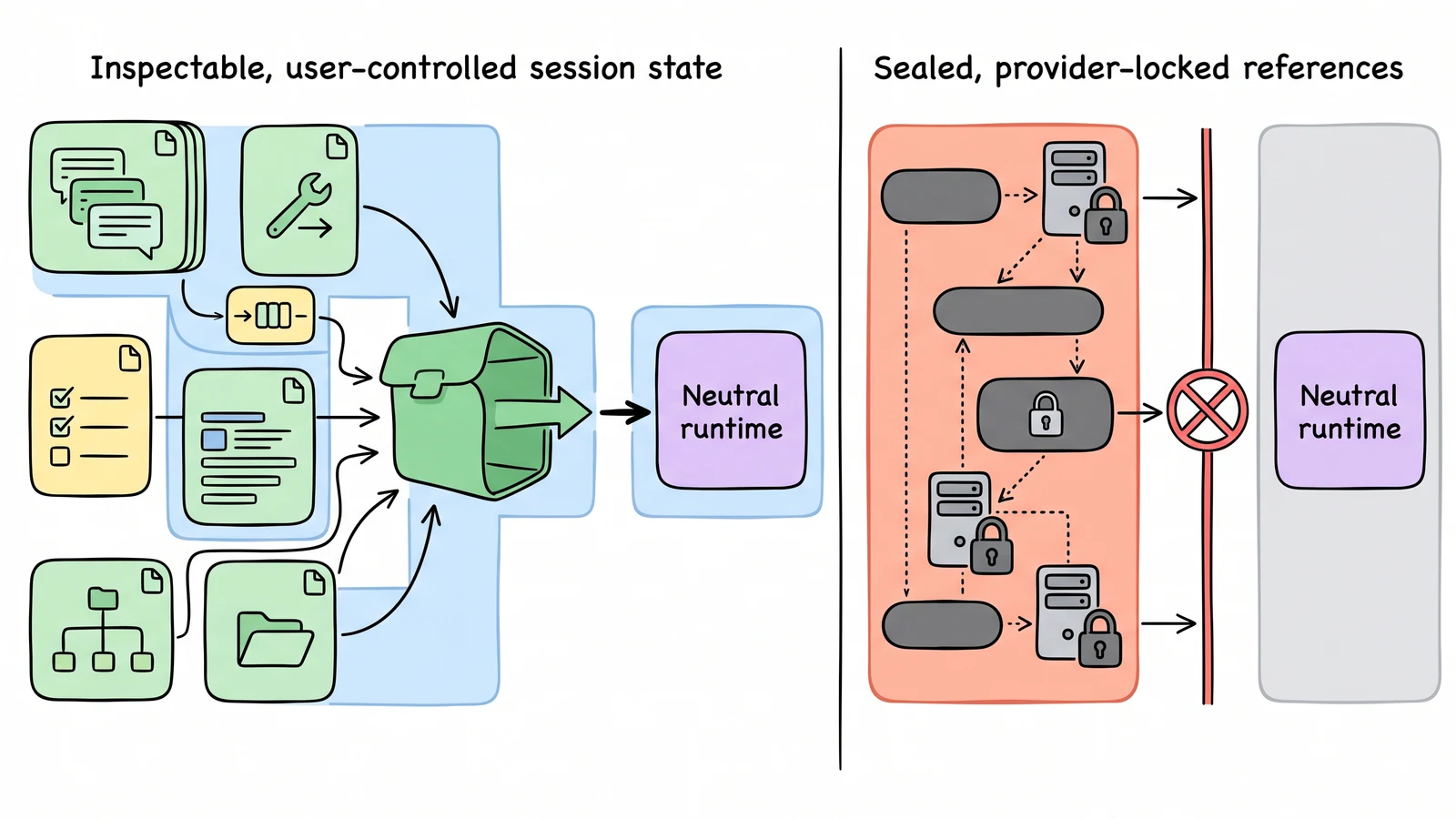
Conversation history is no longer the same thing as an agent session. Long-running work accumulates reasoning artifacts, hosted-search evidence, compaction, subagent messages, file and vector-store references, container state, and caches. If those remain behind provider IDs, an export moves only the outer transcript.
Earendil offers a useful boundary: a response ID is not a transcript, ciphertext without a user-controlled key is not user-controlled state, and a list of citations is not the retrieved passages and ranking the model actually saw. This state is better described as provider-sealed.
A portable export should contain messages, tool calls and complete results, search queries and retrieved passages with timestamps, readable compaction summaries, the subagent tree, an artifact manifest, prompt-tool-model versions, and file references that resolve outside the source platform.
The acceptance test is replay. Load the bundle into a second runtime, ask it to explain prior decisions, continue the task, and delete the imported state. Opaque blobs, dead file IDs, or a missing evidence chain are portability failures. Provider-native sealed state may improve continuation inside one ecosystem, but it should sit beside a readable handoff rather than replace it.