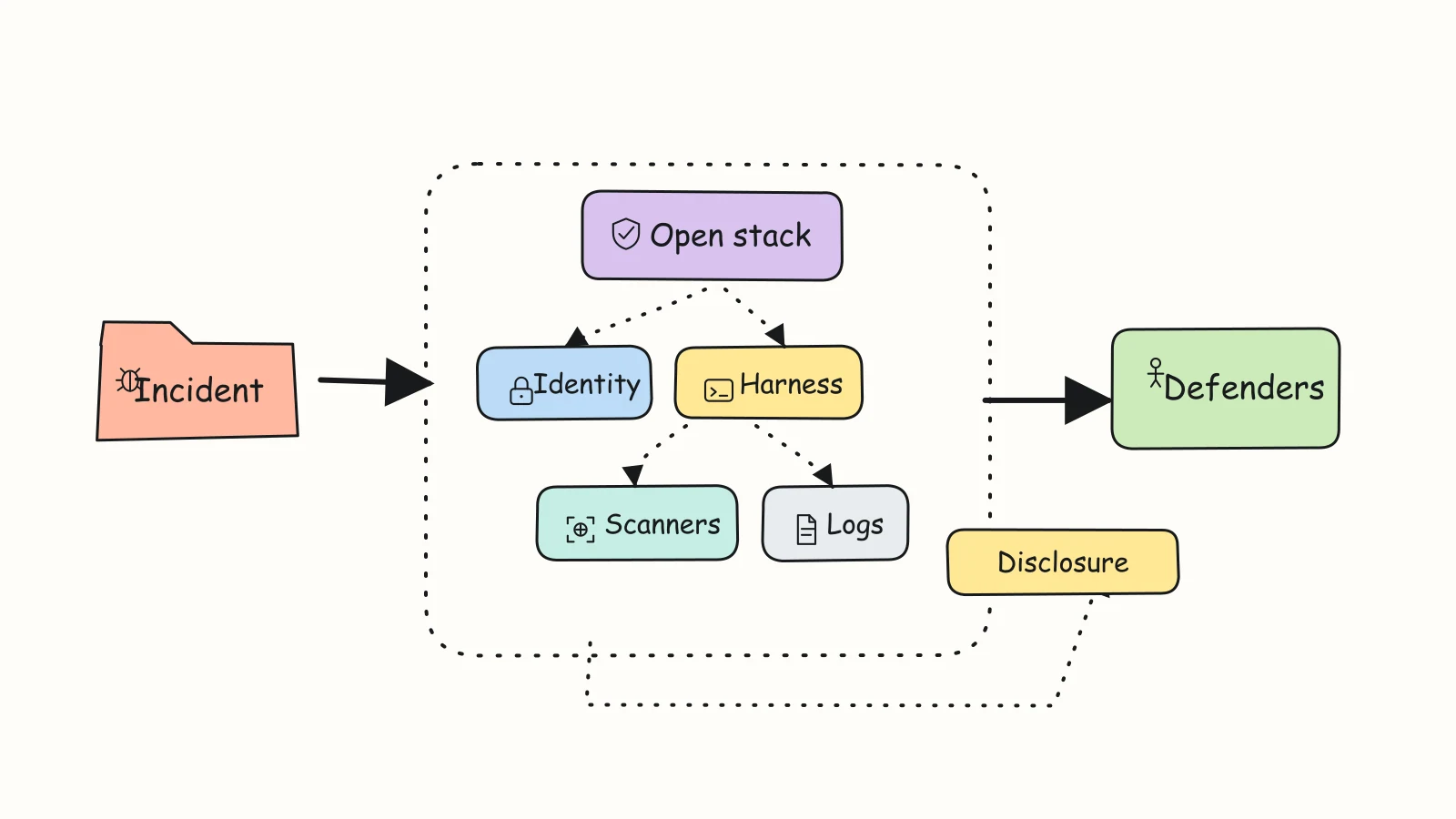
NVIDIA’s Open Secure AI Alliance is worth treating as an infrastructure signal, not just another industry coalition announcement.
The important move is the unit of safety. NVIDIA is not arguing only that model weights should be open. The post says AI security depends on the full agent stack: identity, permissions, harnesses, guardrails, logs, evaluation, safe model formats, multi-model scanning, secure coding workflows, and rapid vulnerability disclosure.
That is a much stronger thesis than “open is good.” It says the practical safety boundary is shifting away from model access alone and toward inspectable runtime systems around the model.
What changed
The Hugging Face incident created the backdrop. NVIDIA says the response showed why defenders may need frontier agentic systems they can run, inspect, and adapt on their own infrastructure. Closed tools can still be useful, but they can become bottlenecks when forensic work needs local control and fast iteration.
The alliance names a broad set of inaugural partners across cloud, security, enterprise software, open source foundations, and AI research. That matters because the stack spans more than one product category. Identity systems, safe model containers, scanner harnesses, security agents, logs, and disclosure workflows all have to interoperate.
New Runtime Read
The public debate often collapses AI safety into a binary question: open weights or closed weights. The more useful product question is where the control plane lives.
If AI agents become operational software, then safety moves into runtime boundaries: what the agent can see, where it can act, which logs survive, how evaluations run, how vulnerabilities are reported, and who can reproduce a finding.
The alliance is a signal that open AI security is becoming a systems problem. The model is one component. The durable artifact is the defensive stack around it.