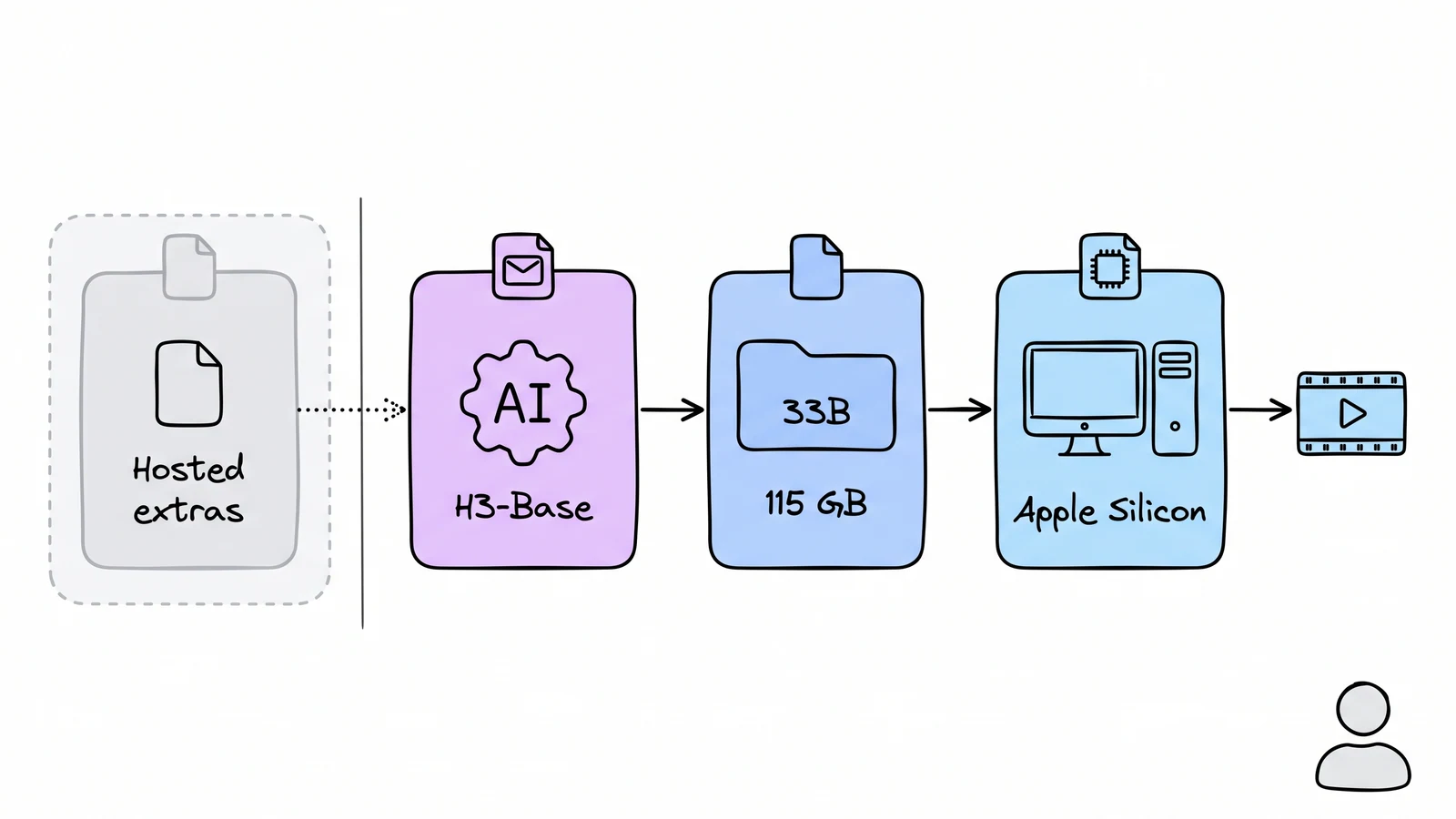
MiniMax released H3-Base, the foundation checkpoint behind its new video system, and PipeNetwork published an MLX port that makes the model runnable on sufficiently large Apple Silicon machines.
H3-Base is a 33B dense single-stream transformer with a Qwen3-VL-32B encoder. MiniMax says roughly 13B parameters belong to conditioning branches that can be precomputed and omitted from inference-only loading. The model accepts text, image, video, and audio conditioning and can produce short video with native stereo audio, but the initial open release does not include every hosted component: H3-Context-IR, H3-Regenerate-2K, and the promised sparse-attention implementation remain outside the first release.
The local proof is real but demanding. Simon Willison reports an approximately 115 GB download and about 45 minutes for one generation on an M5 Max. The official SGLang example assumes four GPUs. The weights use the MiniMax H3 Community License, so 'open weights' is more accurate than 'open source' in the OSI sense.
The release narrows the gap between cloud-only video systems and inspectable local inference, while making the remaining constraints measurable: memory, generation time, missing components, and license terms.