Local Inference Is Crossing More Hardware Tiers, But Configuration Still Defines The Claim

Quantization and sparse architectures are moving useful models onto phones, unified-memory Macs, and homelab servers, but speed, context, heat, battery, loader maturity, and memory remain configuration-specific constraints.

Retrieval answer

The three sources are hardware-threshold signals, not one benchmark. Claims must name model variant, quantization, active and total parameters, context, backend, RAM/VRAM, decode speed, and power or thermal limits.

New Runtime synthesiseditorial-diagram
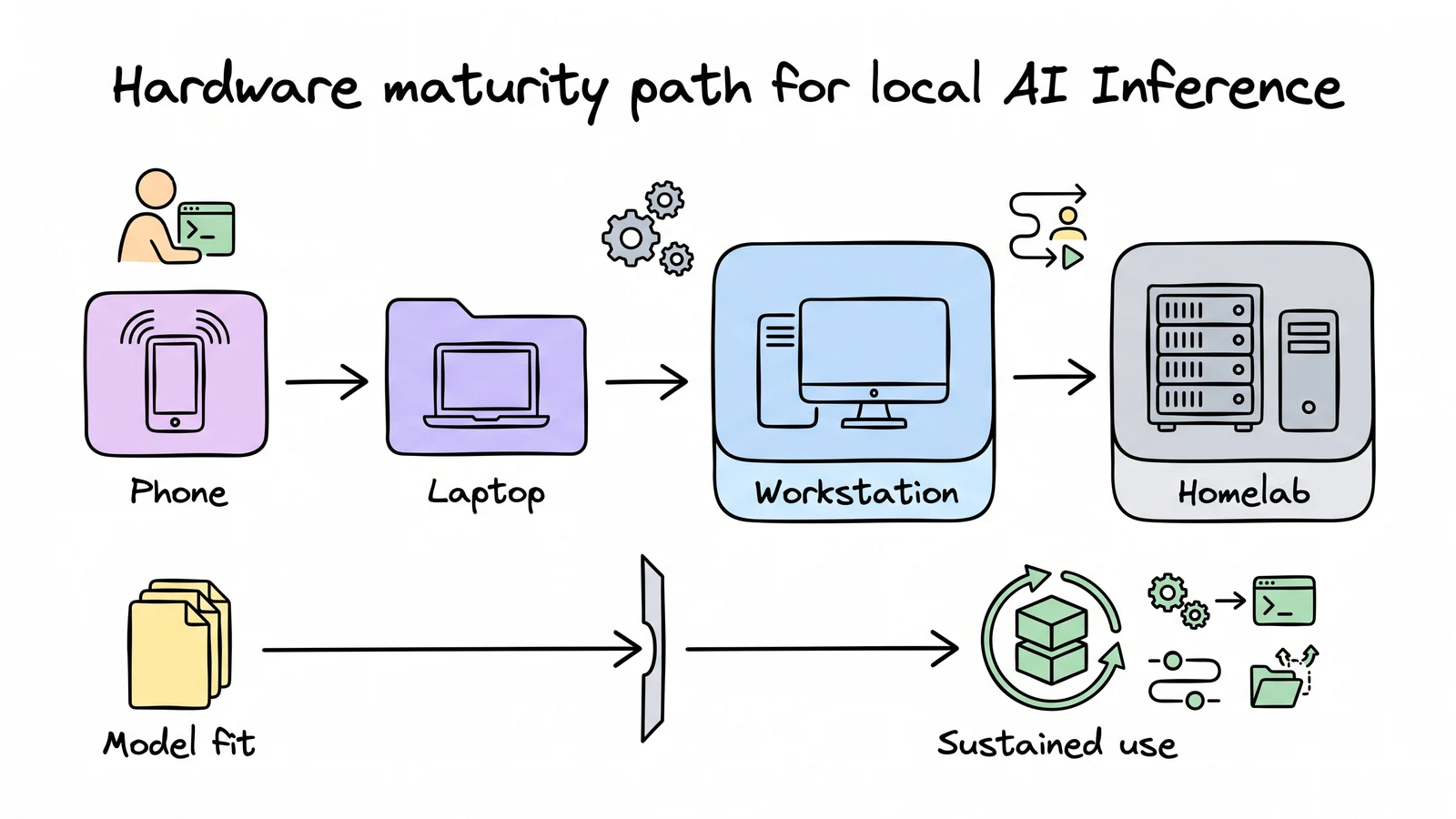
A whiteboard maturity path across phone, laptop, workstation, and homelab, with a separate gate between model fit and sustained usable inference.
New Runtime synthesis from Unsloth, Gemma on iPhone, and DeepSeek V4 Flash local configurations.New Runtime synthesisOriginal source ->

Field note

Three experiments show the local-inference boundary moving across different hardware tiers. Unsloth says a forthcoming Qwen3.8-27B configuration will fit in 17 GB. A community Gemma run reaches an iPhone 13 Pro with severe speed and memory limits. DeepSeek V4 Flash can be quantized and served locally, but its 284-billion-parameter mixture-of-experts weights still make memory and loader support the hard constraints.

These are not comparable performance records. A model fitting in memory does not imply interactive speed, useful context, thermal stability, or acceptable battery life. Sparse activation reduces compute per token but does not remove the need to store the full weight set. Experimental forks and aggressive quantization can also change reliability.

Every local claim should carry a configuration contract: exact checkpoint, quantization, backend and commit, RAM and VRAM, context size, prompt and decode speed, power, heat, and quality delta. The trend is real—more capability is available without a hosted API—but the operational threshold is a matrix, not one headline number.

Recommendation

Quantization and sparse architectures are moving useful models onto phones, unified-memory Macs, and homelab servers, but speed, context, heat, battery, loader maturity, and memory remain configuration-specific constraints.

Discovery graph / next reads

Continue through New Runtime

Open the graph
  1. 01topicLocal Inference - New RuntimeExplore the local-inference topic hub.
  2. 02topicQuantization - New RuntimeExplore the quantization topic hub.
  3. 03topicEdge Ai - New RuntimeExplore the edge-ai topic hub.
  4. 04archiveField NotesOpen the latest editorial analysis.
  5. 05source ledgerSource LedgerInspect the public source evidence graph.

These links are also published in this page's JSON twin and as typed edges in DiscoveryGraph v1.

Who read this page?Machine requests, hidden until opened

Loading the privacy-safe route aggregate...

Open the JSON contract