LangChain Turns Agent Evals into a Spec-to-Task Production Pipeline

LangChain separates world knowledge, task specifications, environments, and graders so teams can continuously build representative agent evaluations.

Retrieval answer

LangChain's environment workflow treats representative agent evaluation as a maintained production pipeline rather than a one-time benchmark-writing exercise. LangChain explicitly says the process is iterative and not fully autonomous, so the guide is a workflow proposal rather than evidence that benchmark creation has been solved.

New Runtime synthesiseditorial-diagram
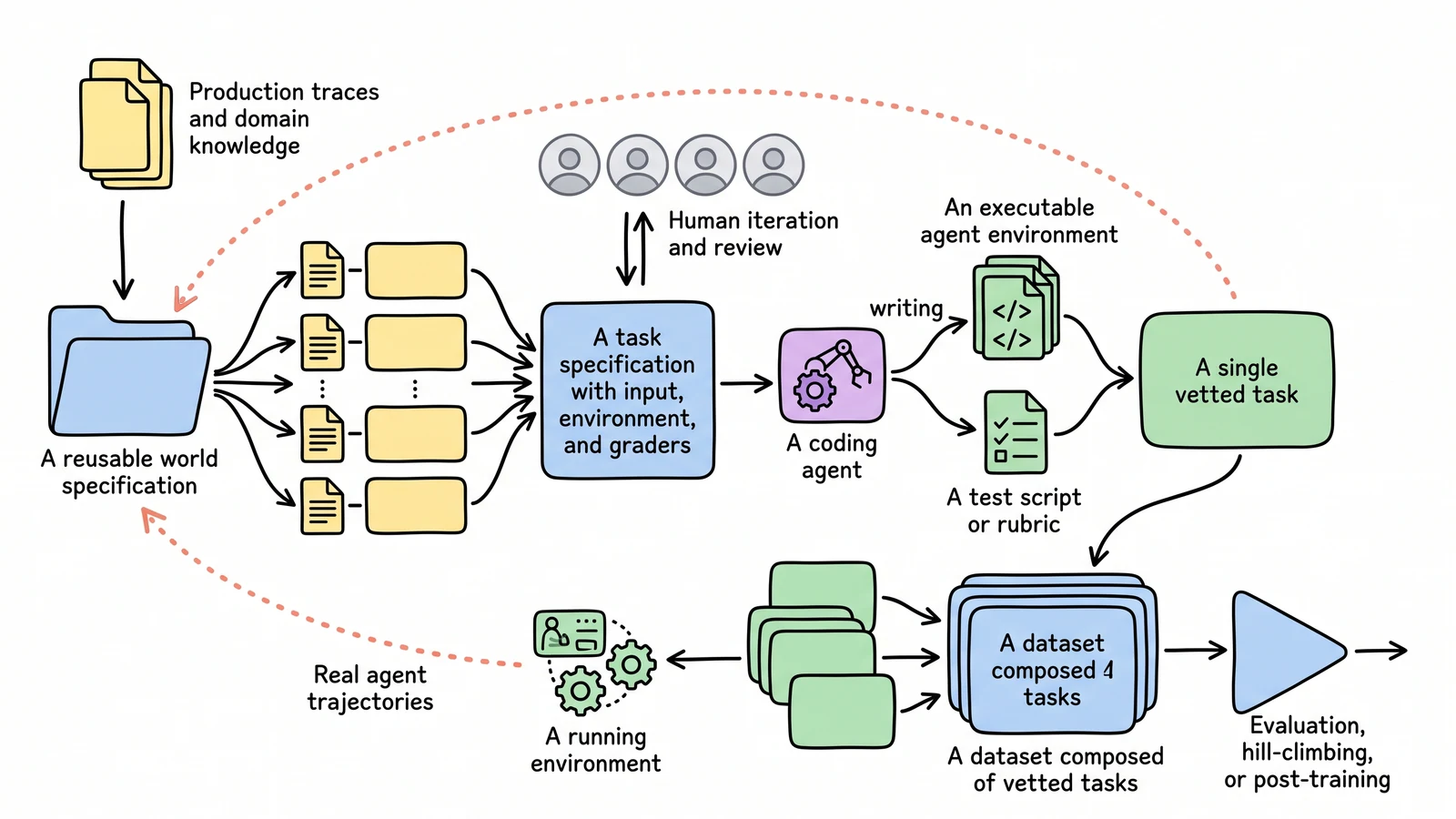
Whiteboard pipeline from traces and world knowledge to reviewed task specs, generated environments, tests, datasets, and evaluations.
New Runtime synthesis of LangChain's agent environment and task-building process. Source: https://www.langchain.com/blog/building-agent-environments-and-tasksNew Runtime synthesisOriginal source ->

Field note

LangChain's environment workflow treats representative agent evaluation as a maintained production pipeline rather than a one-time benchmark-writing exercise.

The method is timely because agent performance can only improve reliably when production traces and domain knowledge become repeatable tasks with observable failure modes. LangChain describes a two-step pipeline that first creates a task specification and then turns that specification into an executable task and environment. A shared world specification carries project knowledge, scripts, schemas, and grading guidance across tasks, while humans still refine task realism and difficulty.

The workflow separates human-readable specification from executable construction, allowing teams to review intent before agents generate environments, synthetic data, and graders. Teams should version world specs and task specs, run real agents through generated environments, inspect trajectories, and keep humans responsible for realism and difficulty calibration.

LangChain explicitly says the process is iterative and not fully autonomous, so the guide is a workflow proposal rather than evidence that benchmark creation has been solved. Revise the conclusion after teams publish cross-domain results on task validity, maintenance cost, leakage, reward hacking, and improvements transferred back into production agents.

Recommendation

LangChain separates world knowledge, task specifications, environments, and graders so teams can continuously build representative agent evaluations.

Discovery graph / next reads

Continue through New Runtime

Open the graph
  1. 01topicLangchain - New RuntimeExplore the langchain topic hub.
  2. 02topicAgent Evals - New RuntimeExplore the agent-evals topic hub.
  3. 03topicSkills - New RuntimeExplore the skills topic hub.
  4. 04archiveField NotesOpen the latest editorial analysis.
  5. 05source ledgerSource LedgerInspect the public source evidence graph.

These links are also published in this page's JSON twin and as typed edges in DiscoveryGraph v1.

Who read this page?Machine requests, hidden until opened

Loading the privacy-safe route aggregate...

Open the JSON contract