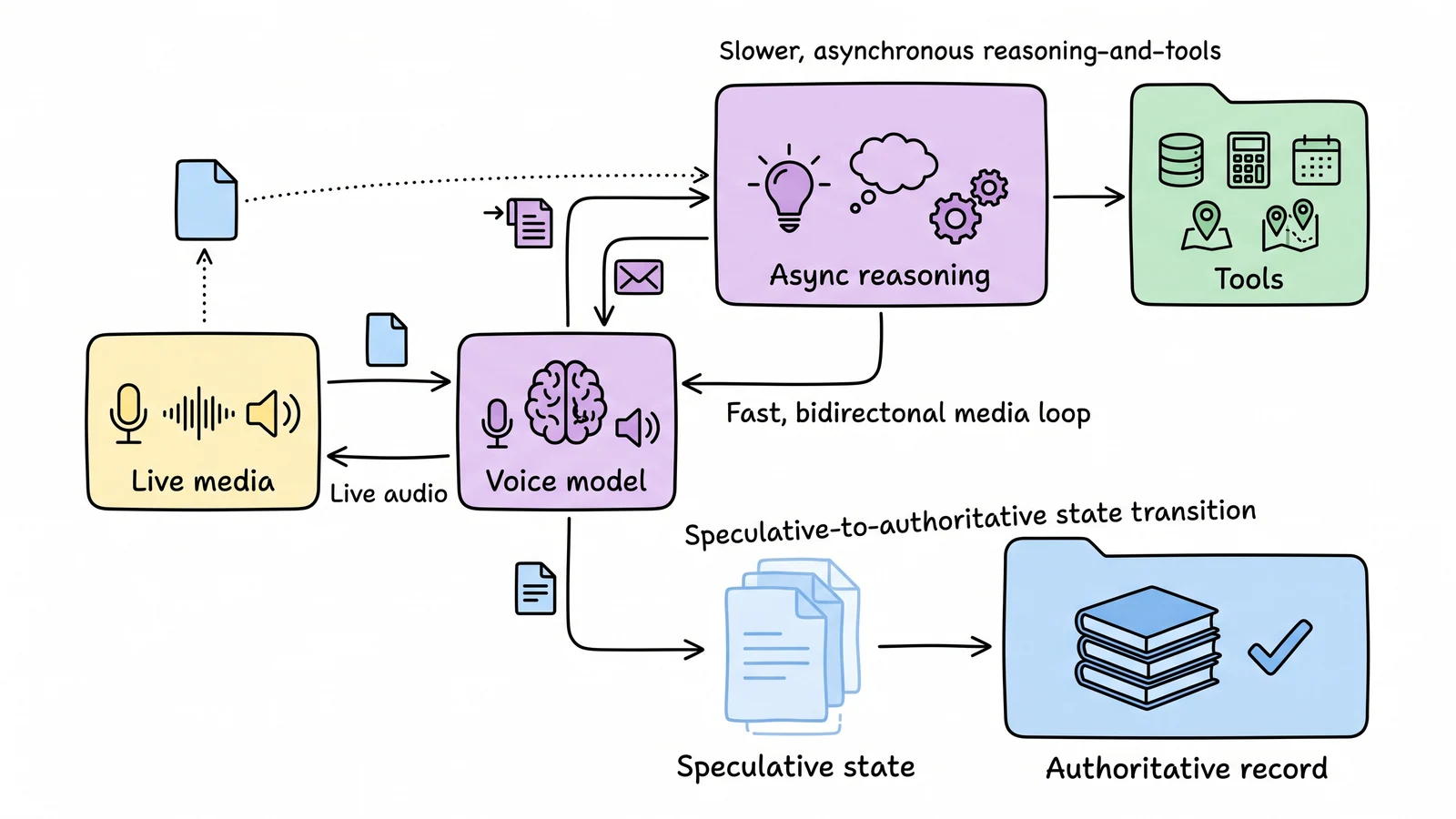
GPT-Live replaces turn-detection-first voice architecture with a continuous full-duplex media loop. Audio streams into and out of a stateful voice model; deeper reasoning, tool calls, persistence, and application logic sit behind an asynchronous boundary, so a slow backend cannot stall speech.
State is handled as a live migration problem. A replacement model instance can be warmed with the current context, run alongside the active instance, and take over when ready. The same mechanism supports context compaction without an audible pause. Continuous speech is also represented in two forms: a speculative view that can change and an authoritative transcript for analytics and downstream systems.
The reusable pattern is a small latency-critical loop plus asynchronous intelligence. Voice, computer control, and other realtime agents can stay responsive while slower reasoning remains useful. The transport details matter too: OpenAI says its WARP work collapses WebRTC startup from six round trips to one, while production shadow traffic exposed CPU, network, geography, and session-lifecycle limits that ordinary GPU load tests missed.