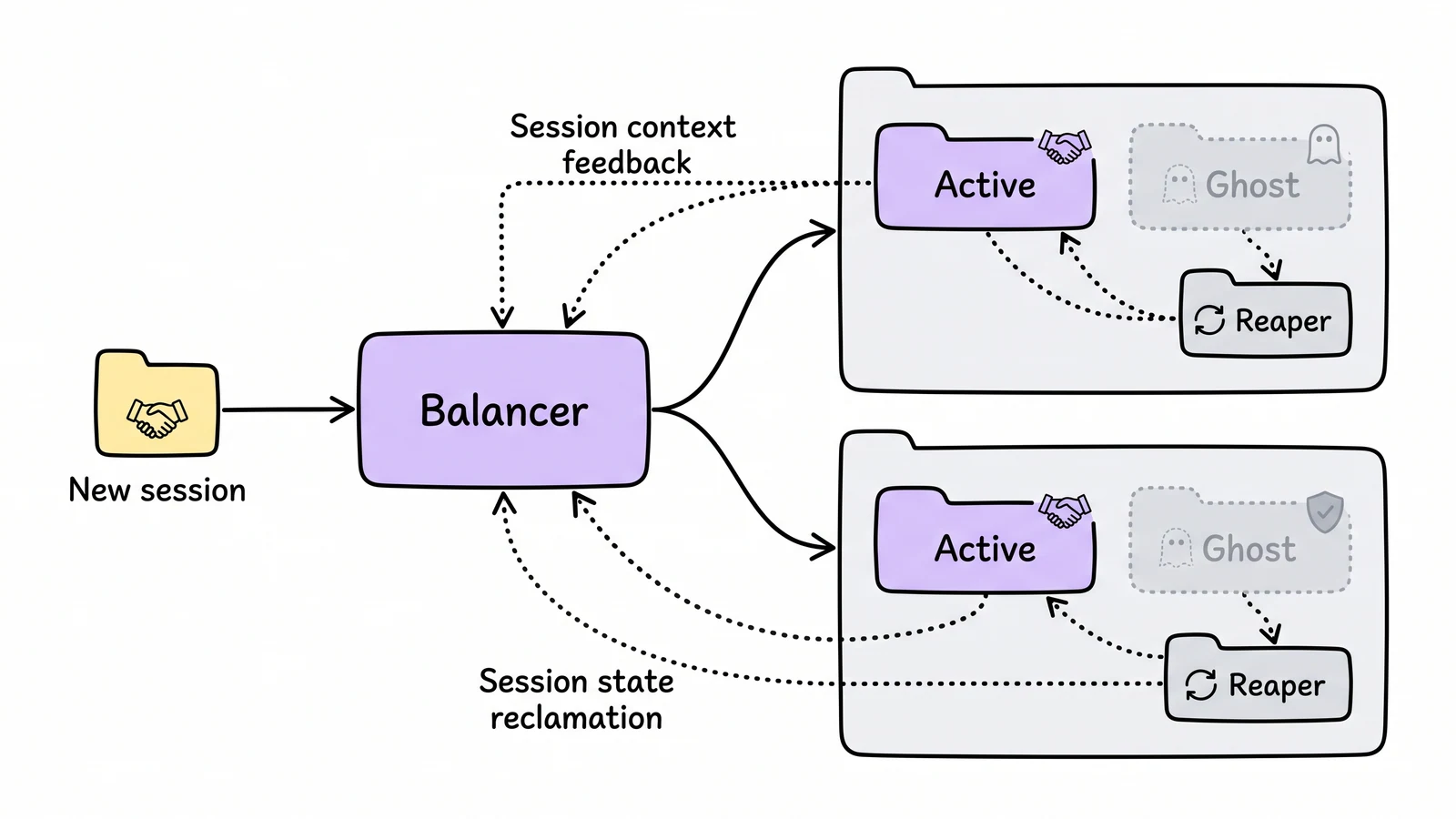
Google described a session-aware load-balancing pattern for real-time voice and streaming agents. Conventional QPS or instantaneous CPU signals can look healthy while a worker is already committed to long conversations that will continue consuming state and compute.
The proposed control plane tracks active sessions, sessions that disappeared without a clean close, expected per-session cost, and CPU pressure normalized by session count. Routing therefore considers future commitments, not only the current request snapshot.
Ghost-session handling matters because mobile disconnects and network failures leave stale capacity reservations. A reaper and timeout policy must reclaim them without terminating a conversation that is merely reconnecting. Session stickiness also has to coexist with overload protection and regional failover.
The broader lesson applies beyond voice: any agent with streaming output, tools, memory, or a persistent remote environment consumes a temporal reservation. Infrastructure should schedule that reservation explicitly instead of pretending each HTTP request is independent.