Double-Blind Evals Move Benchmark Integrity into the Runtime

Google DeepMind's pilot uses confidential computing so evaluators keep prompts private while the model owner keeps proprietary weights private.

Retrieval answer

Double-blind model evaluation makes benchmark integrity a property of the execution environment rather than a promise between organizations. The pilot demonstrates an architecture for one model and partner group; it does not yet establish broad interoperability or eliminate flaws in benchmark design and grading.

New Runtime synthesiseditorial-diagram
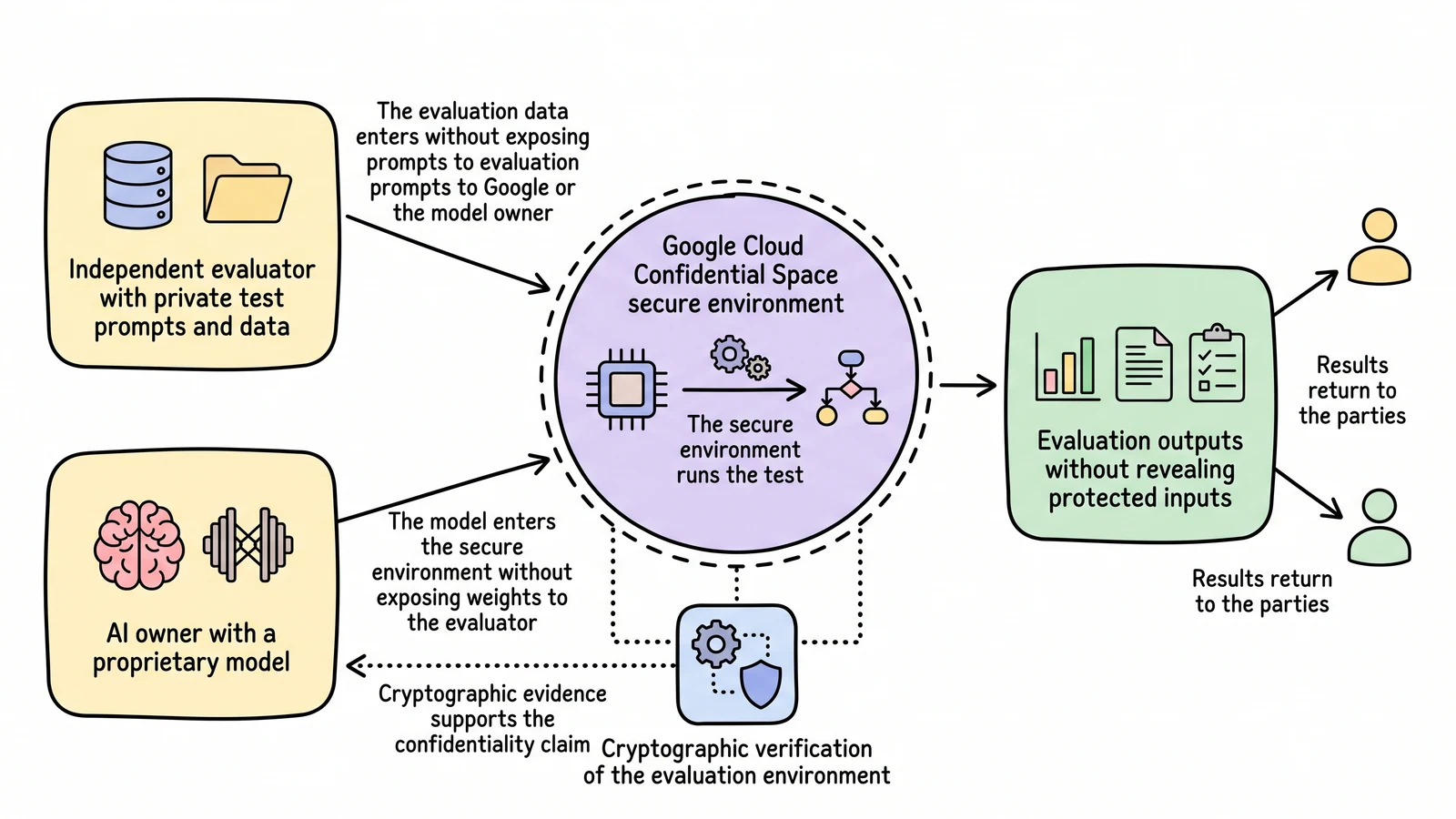
Whiteboard diagram of a model owner and evaluator sending protected assets into a secure enclave that returns evaluation evidence.
New Runtime synthesis of Google DeepMind's double-blind evaluation workflow. Source: https://deepmind.google/blog/piloting-the-worlds-first-double-blind-ai-evaluationsNew Runtime synthesisOriginal source ->

Field note

Double-blind model evaluation makes benchmark integrity a property of the execution environment rather than a promise between organizations.

The pilot is timely because benchmark contamination can inflate scores while external evaluators and model providers both have legitimate reasons to protect sensitive assets. Google DeepMind is piloting a proprietary Gemini Flash Lite evaluation with the Singapore AI Safety Institute, OpenMined, AVERI, and MLCommons. The design uses Google Cloud Confidential Space so the evaluator cannot inspect model weights and Google cannot inspect confidential evaluation prompts.

A cryptographically verifiable confidential-computing environment binds the model and hidden benchmark at execution time without handing either party the other's protected material. High-stakes evaluators should treat isolation, attestation, logging, and prompt custody as part of the benchmark contract, not as administrative detail.

The pilot demonstrates an architecture for one model and partner group; it does not yet establish broad interoperability or eliminate flaws in benchmark design and grading. Revise the conclusion after independent replications report attestation details, failure handling, cost, and whether the method prevents operational leakage across multiple providers.

Recommendation

Google DeepMind's pilot uses confidential computing so evaluators keep prompts private while the model owner keeps proprietary weights private.

Discovery graph / next reads

Continue through New Runtime

Open the graph
  1. 01topicDeepmind - New RuntimeExplore the deepmind topic hub.
  2. 02topicEvals - New RuntimeExplore the evals topic hub.
  3. 03topicConfidential Computing - New RuntimeExplore the confidential-computing topic hub.
  4. 04archiveField NotesOpen the latest editorial analysis.
  5. 05source ledgerSource LedgerInspect the public source evidence graph.

These links are also published in this page's JSON twin and as typed edges in DiscoveryGraph v1.

Who read this page?Machine requests, hidden until opened

Loading the privacy-safe route aggregate...

Open the JSON contract