ChainDrop Shows Why Agent Security Starts With Identity And Release Authority

ChainDrop propagated through stolen npm, GitHub, cloud, Kubernetes, and Vault identities; IBM's agent identity model supplies the governance layer of scoped delegation, short-lived credentials, revocation, and signed audit trails.

Retrieval answer

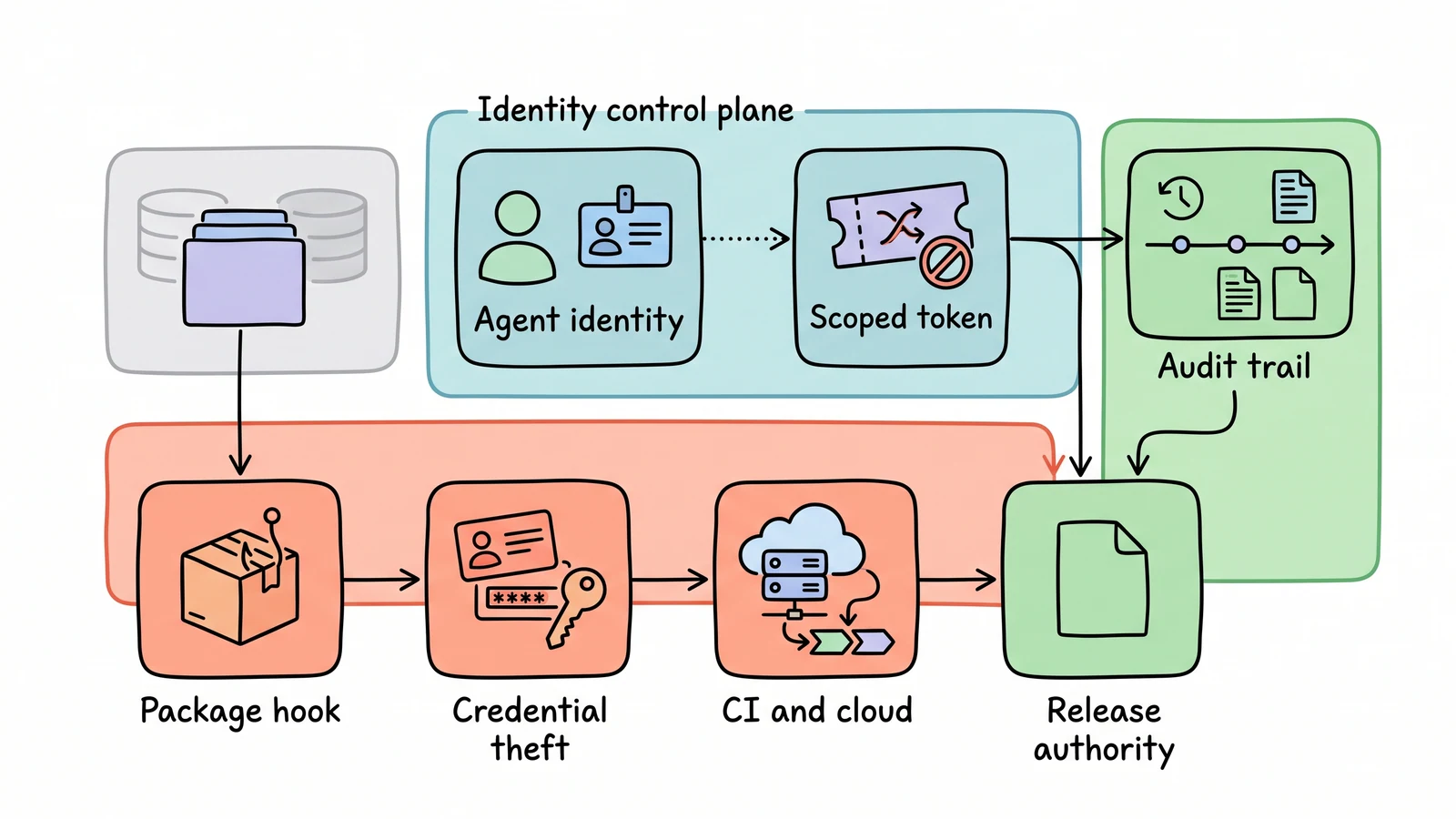
The attack moved from a malicious npm preinstall hook to credential theft, package republishing, CI/OIDC abuse, and agent configuration persistence. The defensive unit is an attributable identity with task-scoped authority, not a shared secret inside an agent context.

New Runtime synthesiseditorial-diagram
A whiteboard two-layer diagram showing the ChainDrop credential-propagation path beneath an identity control plane with scoped tokens, release gates, and audit trails.
New Runtime synthesis from ChainDrop supply chain compromise and agentic identity management.New Runtime synthesisOriginal source ->

Field note

Microsoft's ChainDrop analysis traces a self-propagating npm compromise across more than 400 packages. A malicious preinstall hook ran before installation completed, harvested npm, GitHub, cloud, Kubernetes, and Vault credentials, then used recovered release authority to modify and republish additional packages. Stolen GitHub access also injected Claude and VS Code configuration files as a secondary persistence path.

The attack chain is about identity multiplication. One compromised maintainer token can become package writes, workflow access, cloud enumeration, secret-store reads, and releases with legitimate-looking provenance. Rotating a single token is not enough when build runners, caches, OIDC trust, and downstream artifacts may already be contaminated.

IBM's agent identity framing provides the organizational counterpart: unique agent identities, delegated user intent, just-in-time task-scoped credentials, runtime authorization at every tool call, instant revocation, and signed audit trails. Applied to coding agents, the release credential should appear only at the egress boundary, never inside the model context or general-purpose sandbox.

Recommendation

ChainDrop propagated through stolen npm, GitHub, cloud, Kubernetes, and Vault identities; IBM's agent identity model supplies the governance layer of scoped delegation, short-lived credentials, revocation, and signed audit trails.

Discovery graph / next reads

Continue through New Runtime

Open the graph
  1. 01topicSupply Chain Security - New RuntimeExplore the supply-chain-security topic hub.
  2. 02topicAgent Identity - New RuntimeExplore the agent-identity topic hub.
  3. 03topicCredentials - New RuntimeExplore the credentials topic hub.
  4. 04archiveField NotesOpen the latest editorial analysis.
  5. 05source ledgerSource LedgerInspect the public source evidence graph.

These links are also published in this page's JSON twin and as typed edges in DiscoveryGraph v1.

Who read this page?Machine requests, hidden until opened

Loading the privacy-safe route aggregate...

Open the JSON contract