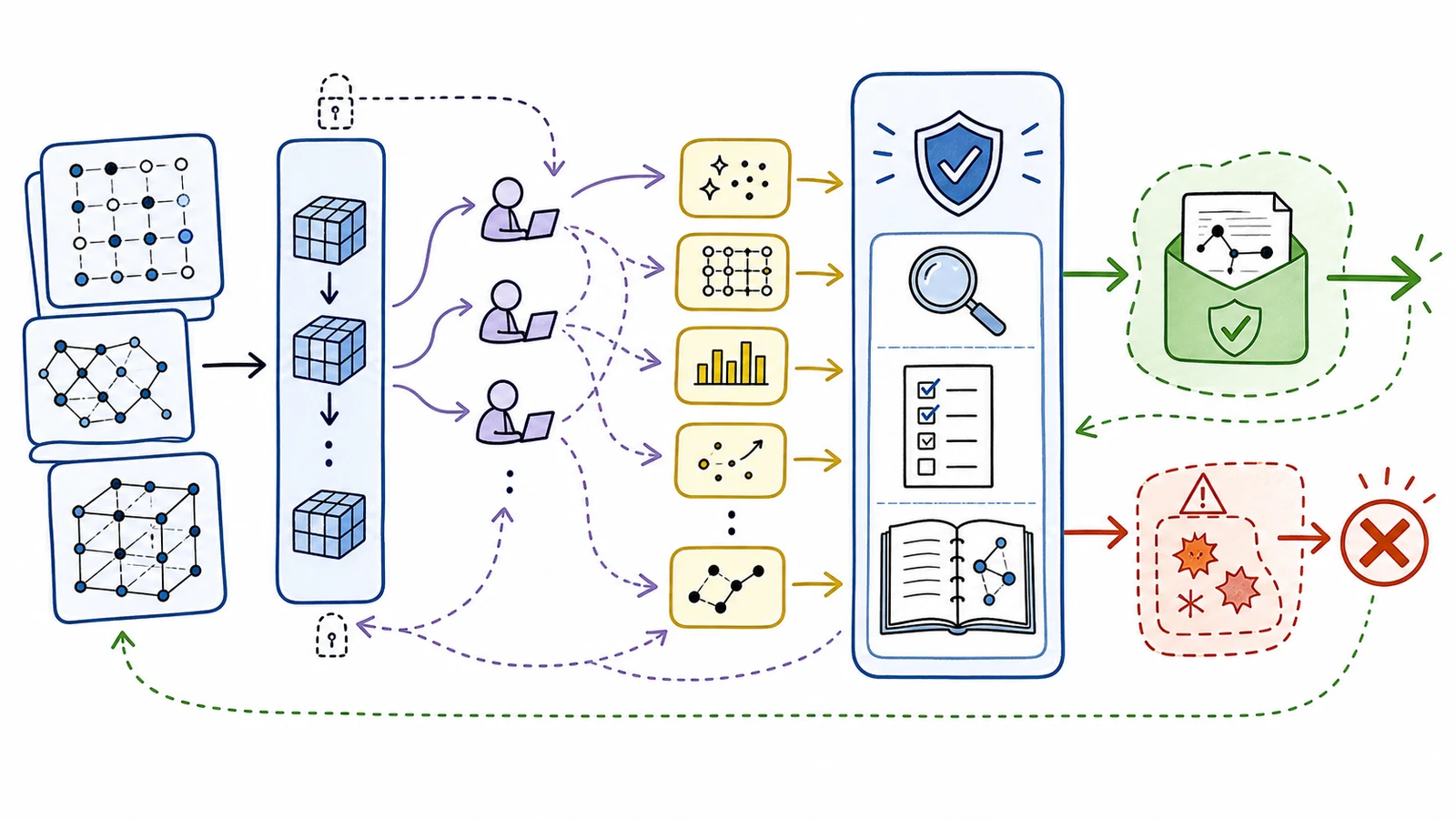
Anthropic’s cryptography post is not a normal “AI found bugs” story. The public evidence spans 5 source links and points to a narrower bottleneck: a frontier model can generate cryptographic attack ideas quickly, but human validation, disclosure, and production-impact assessment remain the scarce control surface.
The important shift is that Claude Mythos Preview did not only find implementation mistakes in software. Anthropic says it found mathematical weaknesses in cryptographic algorithms themselves: an improved attack on HAWK, a post-quantum digital signature candidate, and an improved attack on a reduced-round version of AES.
The caveat matters. Anthropic says neither result affects production systems today. HAWK is a candidate scheme rather than a deployed standard, and the AES work targets a seven-round variant, not full AES-128. This is cryptographic review doing its job before a weakness becomes a production incident.
What changed?
For HAWK, Anthropic says Mythos found a nontrivial automorphism in the lattice used by the scheme. The resulting faster enumeration attack effectively cuts the proposed key strength sharply; for the small HAWK-256 size, the post says the expected full key recovery cost moved from roughly 2^64 to 2^38.
For AES, Mythos found what it called a Mobius Bridge idea for a seven-round AES-128 variant. Anthropic says the attack improves previous meet-in-the-middle approaches by 200-800x, while still being impractical and not breaking the full cipher.
The workflow details are the real signal. Anthropic describes a Claude Code-like harness with multiple worker agents, sandboxed computational tools, literature review, hypothesis search, and verification pipelines. The HAWK finding took about 60 hours and roughly $100,000 in API cost. The AES idea was found in about a week, but researchers then spent several hundred hours gaining confidence in the claim and preparing the paper.
New Runtime Read
This is a clean example of the verification-throughput bottleneck.
Frontier models are becoming fast at generating plausible, novel technical work. That is useful only when the surrounding system can decide what is real. In domains like cryptography, the limiting resource shifts from “can the model propose an idea?” to “can experts verify novelty, correctness, impact, and disclosure policy quickly enough?”
The future security workflow is not a model alone. It is a research harness, a sandbox, a benchmark, an audit trail, expert review, and a policy gate. The systems that win will not just generate more candidate findings. They will make those findings cheaper to falsify.